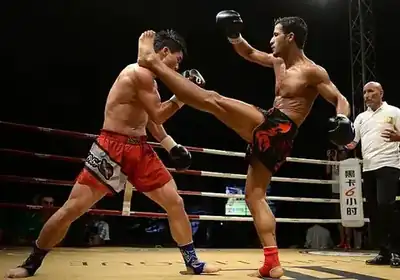
K1 and Point Fighting both sit under the wider kickboxing umbrella, but they create very different tactical environments. One is a continuous ring ruleset with full-contact striking; the other is a controlled stop-start tatami discipline where a recognised score pauses the action.
At Onyx we deliberately value skills from both. We want athletes who can manage the sustained pressure and combination depth of K1 while also developing the timing, acceleration and distance awareness that Point Fighting demands.
The biggest difference: continuous vs stop-start
In Point Fighting, the action is halted after a recognised score. The athlete's problem is often to win a single exchange cleanly. In K1, the athlete must continue through the exchange until the referee calls a break or the round ends.
That means K1 combinations can develop over several beats, while Point Fighting often rewards the ability to create one decisive opening and leave safely.
Distance
Point Fighting tends to encourage longer-range movement and explosive closing of distance. K1 has to account for punches, body kicks, low kicks and knees across multiple ranges.
Both demand distance management, but the preferred distance can change because the legal weapons change.
Rhythm
Point Fighting athletes often use broken rhythm to trigger a reaction before accelerating into the scoring space. K1 athletes also use rhythm changes, but they must be ready to continue once the first strike lands or misses.
At Onyx we treat rhythm as a skill in itself. Athletes should be able to speed up, slow down, pause, draw a response and then act.
Power
K1 is a full-contact ring discipline. Point Fighting is controlled contact. That is an obvious difference, but it does not mean Point Fighting technique is casual or weak. WAKO requires clean controlled delivery and balance.
For developing athletes, this is important: power is not the first technical layer. If the athlete cannot land cleanly at controlled intensity, increasing power usually magnifies the error.
Combination depth
K1 rewards the ability to layer attacks — for example, using punches to create a kick, using a kick to change stance response, or moving from long range into a knee opportunity. The exchange can keep evolving.
Point Fighting places more value on the quality of the initial read and entry because the reset arrives sooner.
What skills transfer between both?
- Stance and balance
- Footwork and angle changes
- Reaction speed
- Feints and reading responses
- Timing
- Distance management
- Clean technique and recovery
- Composure under pressure
Why Onyx trains both influences
We are building athletes, not just collecting techniques. Point Fighting gives us a strong environment for teaching entry, exit, speed, precision and range. K1 gives us an environment for teaching sustained exchanges, low-kick awareness, knees, combination development and ring craft.
The two styles do not need to compete inside the training room. They can strengthen each other when the coach is clear about the tactical objective.
Which style should a beginner start with?
A beginner does not need to choose a permanent identity on day one. Learn to stand, move, punch and kick correctly first. Once the fundamentals are improving, different rules can be introduced as constraints that teach different tactical behaviours.
At Onyx, competition is optional. Students can benefit from both styles even if they never enter a tournament or ring.
Train the athlete, not just the ruleset.
Try Kickboxing at Onyx Northampton and experience how we blend K1 and Point Fighting principles.
Book your free first classOfficial rules and further reading
This guide is a practical explanation, not a substitute for the rulebook used at a particular event. Sanctioning bodies can amend rules, and WAKO currently lists specific 2026 K1 Style changes on its rules page.