Kickboxing is often spoken about as though it has one universal rule set. It does not. The legal techniques, level of contact, competition area and way action is scored can change substantially between disciplines.
Under WAKO, the main competitive disciplines are split between ring disciplines — Full Contact, Low Kick and K1 Style — and tatami disciplines — Point Fighting, Light Contact, Kick Light and Musical Forms. That structure matters because each discipline asks the athlete to solve a different striking problem.
K1 Style
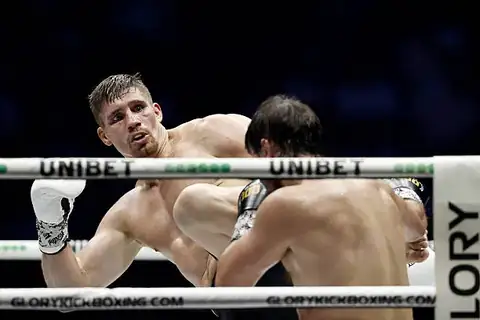
K1 Style is a ring discipline. It allows a broad striking toolkit including punches, kicks, low kicks and knees within the governing rules. The bout is continuous, so athletes must manage exchanges, pressure, defence and position over the whole round rather than resetting after every clean technique.
K1 therefore rewards more than raw force. A powerful strike only becomes consistently useful when the athlete can arrive at the right distance, maintain balance, recover position and continue intelligently after the exchange.
Read the full K1 kickboxing rules guide.
Point Fighting
Point Fighting is a tatami discipline based around clean, controlled scoring. When a valid score is recognised, the action is stopped and the athletes reset. WAKO describes the discipline in terms of controlled technique, speed, agility, balance and focus.
That stop-start structure creates a highly tactical game of range, explosive entry, reaction and exit. It can look lighter than ring kickboxing, but the technical demand on timing and distance is extremely high.
Read the Point Fighting rules guide.
Light Contact
Light Contact is continuous rather than stop-start, but techniques must remain well controlled. It sits between Point Fighting and full-contact ring competition. Athletes work combinations and continuous movement while judges score the quality and effectiveness of legal techniques.
Kick Light
Kick Light is also a controlled continuous tatami discipline, but it brings in legal low kicks to the thigh. WAKO describes it as an intermediate stage between Light Contact and Low Kick competition.
That changes stance, distance and defensive responsibility. Athletes must account for attacks to the lead and rear leg while still maintaining the controlled-contact standard.
Full Contact
Full Contact is a ring discipline using full-power legal techniques. It is more traditional in its kickboxing structure than K1 Style and does not use the same knee-and-low-kick toolkit. The athlete must work continuously and win rounds through effective legal striking.
Low Kick
Low Kick is another ring discipline. It adds legal low kicks to the legs, which significantly changes stance, combination choice and distance management compared with above-waist Full Contact.
Why the ruleset changes the athlete
A ruleset shapes behaviour. Point Fighting encourages explosive entry, precision and immediate recovery. K1 asks the athlete to continue through the exchange, manage low kicks and knees, and stay composed under sustained pressure. Light Contact and Kick Light sit between those extremes and can be useful development environments.
But the fundamentals do not disappear. Across styles, athletes still need balance, vision, positioning, reaction, clean mechanics and the ability to recognise distance.
How this connects to Onyx
We do not want athletes who only know how to hit hard. We want athletes who understand where they are, when to go, how to create the opening and how to leave the exchange in balance.
Our K1 and Point Fighting work therefore feeds the same core development model: movement → technique → rhythm → timing → distance management → decision-making → power.
Power matters. We simply place it later in the sequence, once the athlete can deliver it without losing shape or tactical awareness.
Train both sides of Kickboxing.
Onyx develops K1-style and Point Fighting-style skills for beginners and developing athletes in Northampton.
Book your free first classOfficial rules and further reading
This guide is a practical explanation, not a substitute for the rulebook used at a particular event. Sanctioning bodies can amend rules, and WAKO currently lists specific 2026 K1 Style changes on its rules page.